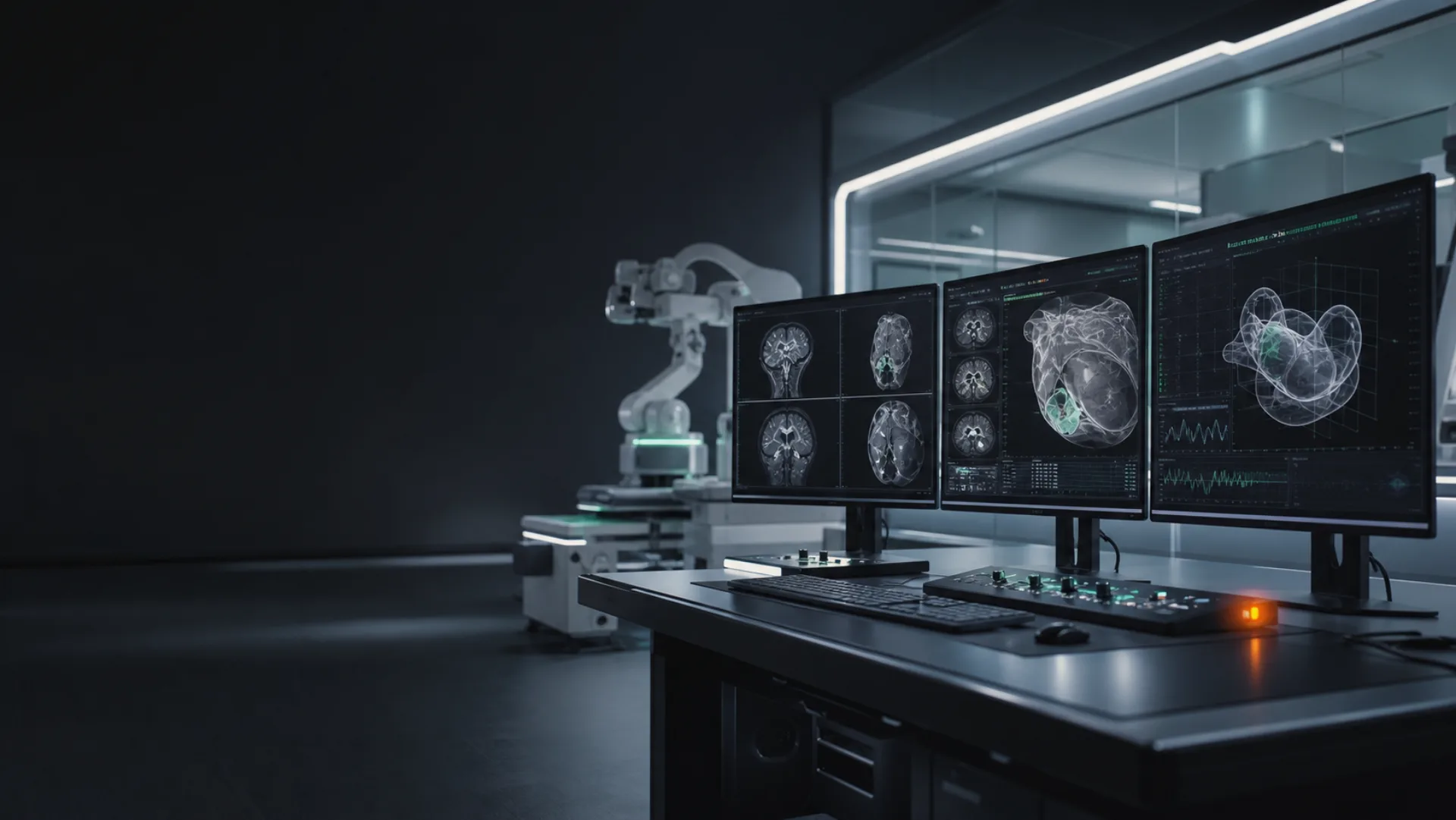
Automated catheter placement system

ORAn automated catheter placement system for safe and accurate automatic positioning and monitoring of the endoclamp balloon for minimally invasive cardiac procedures has been developed in the ARIS*ER Project.
ARIS*ER is a Marie Curie Research Training Network funded by the EU and coordinated by the Interventional Centre. It aims at developing an augmented reality system supporting minimally invasive procedures. An innovative solution for improved control of aortic clamping during minimally invasive cardiac surgery is developed and demonstrated.
Minimally invasive cardiac surgery uses small incisions in order to reduce trauma and risk of infection for the patient. Nevertheless this kind of surgery represents a great challenge for the surgeon, as visual guidance and dexterity are severely impaired.
In order to minimally invasively stop the blood to the heart, a catheter with a balloon at its tip is inserted through the aortic arch close to the aortic valve and inflated in this specific position. Movement either towards the heart or away from it can have serious consequences and so, the knowledge and control of the position of this balloon is a key issue.

Read More »»

Best Paper Award at ICSNC

Ilangko BalasinghamThe paper on "Use of MPEG-21 for Security and Authentication in Biomedical Sensor Networks" by Wolfgang Leister, Truls Fretland and Ilangko Balasingham has been awarded the "Best Paper award" by ICSNC (3rd International Conference on Systems and Networks Communications), in Malta on Oct. 2008.

Read More »»

Best Paper Award at ISABEL 2008

Stig StøaStig Støa from the Interventional Centre and Morten Lindberg and Vera Goebel from Department of Informatics at University of Oslo received the Best Paper Award in the cathegory "Biomedical related topics" at ISABEL 2008 -the First International Symposium on Applied Scineces in Biomedical and Communication Technologies. The paper title is "Online Analysis of Myocardial Ischemia From Medical Sensor Data Streams with Esper".The ISABEL event took place on 25-28 October 2008 and was hosted by Aalborg University in Denmark.

Read More »»

Miniature Ultrasonic Transducers - Continuous monitoring of myocardial function during cardiac surgery

Heart surgery Miniaturized ultrasonic transducers for continuous monitoring of regional myocardial function have been developed and tested at The Interventional Centre. The transducers are fixed on the surface of the heart and give a continuous real-time signal of the heart wall thickening pattern presented on a bedside screen. The aim is to provide a sensitive tool for postoperative monitoring with automated signal analysis and interpretation.
Animal studies have given very good results. The transducers can detect ischemia with high sensitivity,and can discriminate changes during ischemia from other situations with altered hemodynamic variables.
A patient study is currently ongoing to test the ability of the sensors to detect hemodynamic and ischemic myocardial changes in patients during coronary bypass surgery. The study is done in cooperation with Dept. of Thoracic and Cardiovascular Surgery, Dept. of Cardiology, Div. of Anesthesia and Intensive Care Medicine, and Vestfold University College.

Read More »»

Resection Map -A 3D cartographic map to guide laparoscopic hepatectomies

Resection MapA clinical case with an implementation of the Resection Map application from the ARIS*ER Project took place at Rikshospitalet in week 41. The intraoperative navigation solution is a new 3D visualization system to support hepatectomies: the "Resection Map".
This is a pragmatic solution to enhance laparoscopic liver resection accuracy and safety with an intuitive visualization of its critical inner structures. This system aims at improving the transfer of pre-operative liver planning information into the intra-operative surgical stage, both in laparoscopic and open approaches.
Suregeons Dr. Bjørn Ewin and Dr. Arne Rosseland took part in the clinical case together with Dr P.Lamata. The anatomical resection of the first case in Oslo was a success: Dr. Edwin was able to identify and make the correspondence between the structures in the Map (main portal and hepatic veins) and the structures in the patient.

Read More »»

Melody Project Kick-off

leadersFrom left: Arvid Hallén, CEO Research Council of Norway, Ilangko Balasingham, professor, Erik Fosse, professor, Morten Reymert, CEO Rikshospitalet.
A celebration was held on September 8th 2008 celebrating the Kick-off of the Melody Project. Arvid Hallén, CEO Research Council of Norway and Morten Reymert, CEO Rikshospitalet paricipated. A common thread in the project is ultra wide band technology (UWB). The focus of the project is network communication and handling of multiple sensors, positioning systems, tracking systems and guidance of small robots inside the body. The project is planned to be active for the next 7 years and will fund 7 PhD and 15 PostDoc Scholarships. The project is part of the Research Council of Norway's Large Scale ICT Programme.

Read More »»

The MELODY project is supported by the Research Council of Norway's Large Scale ICT Programme

VERDIKT_WSNVERDIKT, the Research Council's large-scale ICT programme has approved the project Medical Sensing, Localization, and Communication using Ultra Wideband Technology (MELODY) Principle investigators are Ilangko Balasingham (The Interventional Centre, Rikshospitalet/NTNU), Tor Ramstad (NTNU), Svein-Erik Hamran (FFI) and Tor Sverre Lande (University of Oslo)
Short project description:
The project will develop ultra wideband (UWB) technology for improved wireless health technology, for both improved network communication and improved and possibly novel medical applications. Three major research directions are pursued, namely short range sensing and imaging of human body, improved sensitivity for short range localization and tracking, and distributed signal and communications for dynamic autonomous resilient networks for both in-vivo and ex-vivo medical applications.
Project duration: 7 years, funding: NOK 49 mill NOK/6.2 mill EUR

Read More »»

MRI used in endoscopic scull base neurosurgery

NeurosurgeryThe new Achieva 3.0T X-series MR supplied by Phillips has been installed at the Interventional Centre, and has been operational from early January 2008. The 3 tesla MR is installed in conjunction with an Operating Room, and patients can be moved back and forth during surgical procedures for MRI scans. So far pre-, and post operative scans during endoscopic neurosurgical scull base procedures. Endoscopy and neuro navigation systems are combined in the operations. Intraoperative MRI scans will be facilitated when a MR-compatible OR table top is installed. A sliding door between the OR and the MR can be opened for access to immediate MRI-scans. The MR can also be used separately, and many clinical reseach groups are using the new magnet including Department of Cardiology, Department of Neurosurgery, and the Pediatric Research Institute from Rikshospitalet. Department of Psychology and the Biophysics Group at Department of Physics at University of Oslo are also involved in research activities including Functional MRI and advanced image processing. Plans to implement and combine High Intensity Focused Ultrasaound with MR Imageing also exists, although the technological platform is still not established.

Read More »»

Industrial robot technology in new Angio OR

Artis ZeegoThe hybrid Angio Suite and Operating Room at the Interventional Centre has been upgraded with the latest genereation of angio systems from SIEMENS. The new system called Artis Zeego is the new name of the Siemens system family for interventional radiology, neurosurgery, cardiovascular surgery and cardiology. The systems is floor-mounted, and has multi-functional configuration, involving a robotic C-arm based on an industrial robot. Several clinical specialties at Rikshospitalet has used the new Angio Suite opened in January 2008 and has already been used by many medical specialties including pediatric cardiology, cardiology, cardiovascular surgery, neuro radiology, neuro surgery.

Read More »»

BWSN Project Showcase Meeting on February 8th 2008

Video from the BWSN Project Showcase Meeting on February 8th 2008 On February 8th the results of the BWSN (Biomedical Wireless Sensor Project) was presented in a Showcase at Rikshsopitalet University Hospital. See the Showcase video on YouTube. The showcase represented implementations from the 18 months long project. Wireless sensors from the projects partners MemsCap (invasive arterial pressure), VTT (pericardial accelerometer), Novosense (ECG) and Millicore (digital pleural drainage system) were used during a live transmission of a surgical experiment from an OR at the Interventional Centre to an auditorium. The image on the left shows the ECG sensor on the thorax and the accellerometer sutured to the anterior pericardial surface. The experimental model included tachycardia, hypovolemia, regional myocardial ischemia and pneumothorax.
The BWSN project was funded by MedCoast, Nordic Innovation Center and NUTEK, and had nine Scandinavian project partners. From Sweden: Acreo, Ericsson R&D, Imego, Novosense and Millicore. From Finland: VTT. From Norway; MemsCap, Novelda and the Interventional Centre. The wireless communication platform developed and implemented in the BWSN project was based on modifications of the IEEE 802.15.4 WPAN standard. The Showcase meeting was held in collaboration with the Wireless Patient Network Project supported by the Norwegian Research Council.
Wireless Healthcare

Read More »»

Scandinavian MR Perfusion Meeting January 31, 2008 at Rikshospitalet

MRIThe main focus of the meeting is MR-perfusion of brain tumors in ordinary clinical use. Target groups are radiologists, radiographers and physicists. Slides from the meeting: Theory & methods, Status new methods, Perfusion v.s MRS,
Faculty: Atle Bjørnerud, professor and John K. Hald, MD, PhD

Read More »»

Information in Norwegian

English is the main language in this web portal. Some information is also available in Norwegian Norwegian text

Donations to Medical Research

The Interventional Centre receives donations to medical research. Questions related to donations can be sent to head of department professor Erik Fosse.

Annual Report 2007

Annual Report 2007

New book about the Interventional Centre

New book about the Interventional Centre

Author: Erik Fosse
Publisher: Det Medisinske Selskap 2007
Price: 180 kr
Online order
Also sold in Bookstores

RSS Feeds